# High in the Mountains, TAMBO Will Hunt for the Highest-Energy Neutrinos
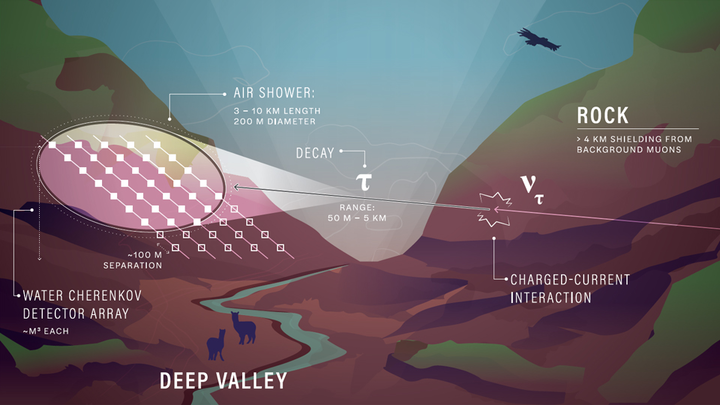
*Left: An Earth-skimming tau neutrino undergoes a charged-current interaction within the left canyon face, producing a tau lepton. The tau lepton emerges from the canyon face into the valley and decays, creating an air shower. This air shower is detected by TAMBO, deployed on the opposite canyon face. (Credit: TAMBO collaboration)*
More than a decade ago, physicists observed the first astrophysical neutrinos from cosmic accelerators, launching a new age in neutrino astronomy. Because they rarely interact with matter, neutrinos can provide a lens into otherwise obscured extreme phenomena, carrying valuable information about their sources. Yet, despite major efforts from different neutrino observatories to identify neutrino sources, the majority of cosmic neutrino sources remain elusive.
This is where [TAMBO](https://tambo.hsites.harvard.edu/), the Tau Air-shower Mountain-Based Observatory, comes in. Instead of ice, TAMBO uses mountains to more precisely detect the highest-energy neutrinos at a fraction of the cost of current and planned observatories. The proposal was recently published in [*Nature Astronomy*](https://www.nature.com/articles/s41550-026-02916-4).[\*](#citation)
A major hurdle in identifying neutrino sources is the million-times stronger background of atmospheric muons and neutrinos that overwhelms the cosmic neutrino signal. TAMBO aims to overcome that by using the valley as a natural shield and honing in on the elusive tau neutrinos, which can travel farther through the Earth’s crust.
“What excites me most about TAMBO is the fundamental physics it opens up,” says Harvard Physics graduate student Pavel Zhelnin. “Tau neutrinos are the least studied particle in the Standard Model because so few have been detected. TAMBO is going to help change that, giving us a way to study them at energies we’ve never been able to reach before.”
Once a tau neutrino interacts with molecules in the rock, it produces another short-lived particle called a tau lepton. After exiting into the valley, it creates an air shower of particles that is then detected by 5,000 plastic sensors on the opposite side of the valley.
“TAMBO is a particularly exciting experiment because we’re pioneering a new approach to neutrino astronomy,” notes Harvard postdoc Will Thompson. "While the IceCube experiment has been fantastically successful in transforming the Antarctic glacier into a neutrino telescope, TAMBO’s goal is to transform a deep valley into one. Finding new ways to use the Earth’s natural features to study neutrinos from beyond our galaxy is one of the most exciting things about working in this field.”
Even though TAMBO will detect fewer neutrinos than IceCube, the purity of TAMBO’s cosmic sample will be substantially higher. At higher energies, the cosmic neutrino signal prevails the atmospheric neutrino background, meaning that any neutrino detected by TAMBO is likely of cosmic origin.
Because TAMBO requires a deep valley with enough surface area and width to work, collaborators are considering the Colca Valley in the Peruvian Andes as a strong possibility.
According to Alberto Gago, a professor at Pontificia Universidad Católica del Peru (PUCP), the TAMBO experiment "will play a unique role in identifying extragalactic neutrinos and give Peru’s high-energy physics community the opportunity to develop a major scientific facility in the country. Beyond its scientific impact, TAMBO could strengthen the national research ecosystem and show policymakers the benefits of a deeper Peruvian role in large-scale international experiments.”
Unique to TAMBO is its mission to spearhead an ethical approach to site selection and construction. Collaborators will work closely with local communities and social scientists to evaluate the environmental and social impacts of building and operating the observatory within the mountain ecosystem.
Deborah Delgado, a sociology professor at PUCP, says she's "especially excited for the opportunity to collaborate with local communities and universities in Arequipa, helping to strengthen STEM education in schools while expanding pathways to higher education."
“With support from the John Templeton Foundation, we are able to uniquely integrate social science into the project, rethinking how we want astronomers and local communities to work together,” explains Jaco de Swart, a Marie Curie postdoctoral fellow at the University of Cambridge and lead on the responsible siting team.
The design and construction of TAMBITO, TAMBO’s prototype and first stage, is currently underway and will serve as a stepping stone for the full TAMBO array, which is expected to be completed in 2028.
In Quechua, the indigenous language spoken in the Andes, tambo means “inn,” a resting place for messengers traversing the mountains. Soon, TAMBO will serve as a refuge for cosmic messengers carrying information from the farthest reaches of the universe.
"The highest-energy universe has a habit of surprising us whenever we develop a new way to observe it,” says Prof. Carlos Argüelles-Delgado. “TAMBO will answer some of today’s biggest questions, but I hope it will also reveal entirely unexpected phenomena. That’s why we want to build it.”
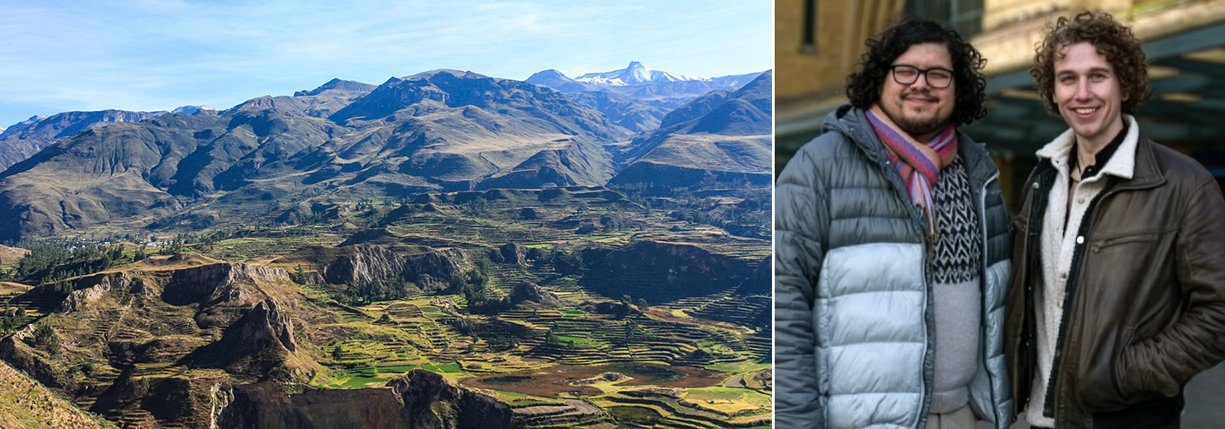
Above left: The Colca Valley in the Peruvian Andes (credit: Patricia van den Berg, pixabay); above right: Carlos Argüelles-Delgado and Jaco de Swart, co-leaders of the interdisciplinary grant that is funding the TAMBO project.
---
The TAMBO Collaboration is made up of 26 institutions in nine different countries (see ). This work was made possible through the support of Grant 63651 from the John Templeton Foundation. Additional support was provided by several Harvard University funds, including the Milton Family Fund, the Faculty of Arts and Sciences Dean's Fund for Promising Scholarship, the Harvard-UTEC Fund, and the Radcliffe Institute for Advanced Study; and the David & Lucile Packard Foundation, the Alfred P. Sloan Foundation, the Research Corporation for Science Advancement, and the Canadian Institute for Advanced Research (CIFAR).
\_\_\_\_\_\_\_\_\_\_
\*TAMBO collaboration: Argüelles, C.A. et al., “Measuring the high-energy neutrino sky using the deep-valley neutrino observatory TAMBO,” Nature Astronomy(2026).