

Celebrating the Inaugural Recipients of the Cutting Prize for Undergraduate Research
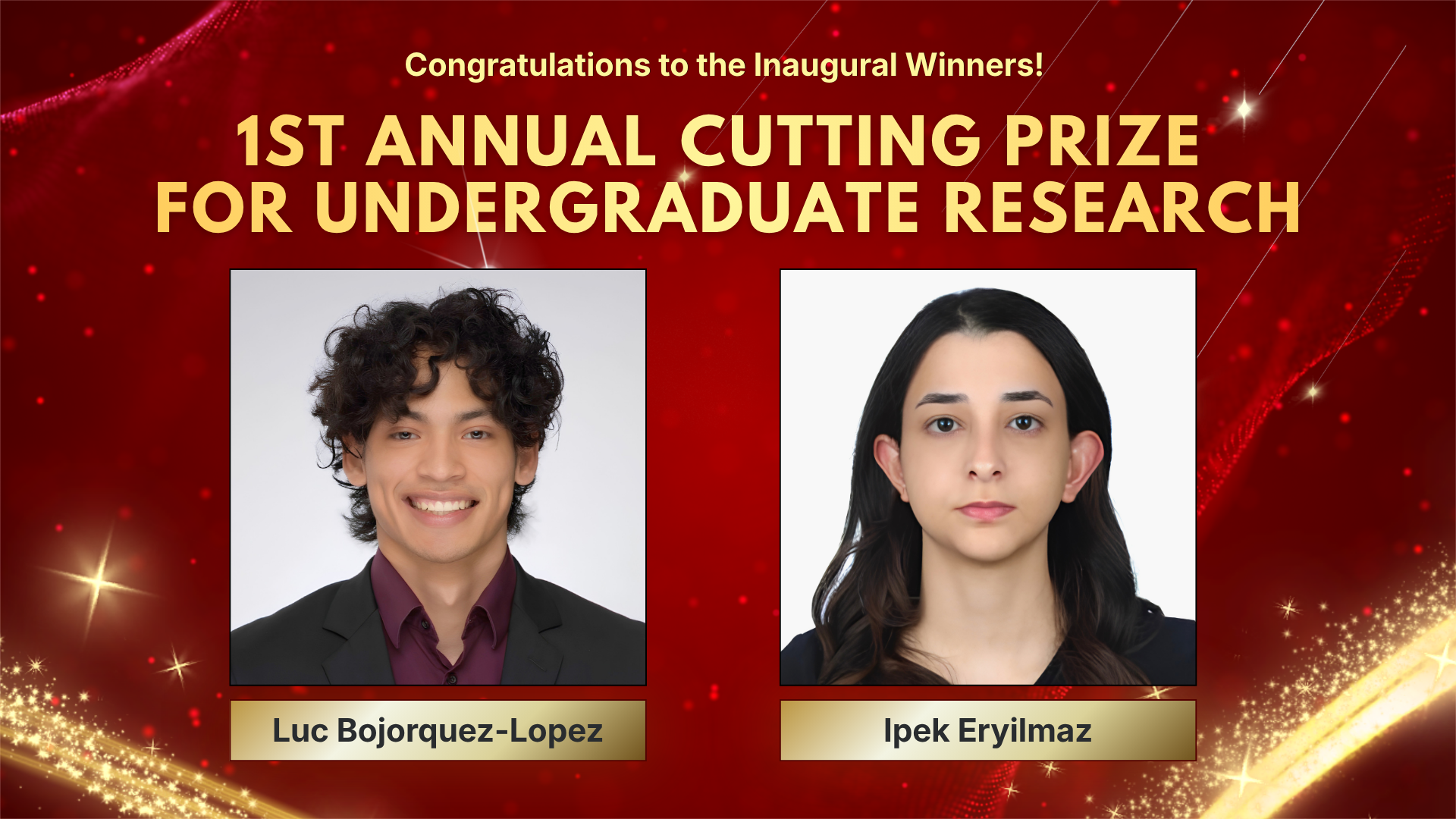
The department congratulates Luc Bojorquez-Lopez (Physics ’26) and Ipek Eryilmaz (Physics and Computer Science ’26), the inaugural recipients of the Cutting Prize for Undergraduate Research. Their research explores opportunities for future neutrino measurements at particle accelerators and neutrino telescopes, as well as new methods for correcting errors in quantum computation. Both students have developed computational tools to address challenging research problems in their respective fields.
Luc Bojorquez-Lopez investigated how a proposed muon collider could also be used to study neutrinos. Working with Professor Carlos Argüelles Delgado, he developed a simulation of neutrino production and interactions, identifying a concentrated region known as the “neutrino slice,” where the collider's detector could record these particles. The work resulted in a first-author publication in Physical Review Letters, one of the leading journals in physics. Additionally, he developed novel methods to identify sub-threshold sources in data from the IceCube Neutrino Observatory. While working with Professor Melissa Franklin, Luc also designed a statistical tool to calculate expected limits on dark matter models and created a graphical interface to make it easier for other researchers to use.
Ipek Eryilmaz developed neural-network methods for decoding errors in quantum computation. Working with Professor Susanne Yelin and graduate researcher Andi Gu, she built a framework for simulating surface-code circuits with transversal logical gates, along with a pipeline for training neural decoders on them. She extended the approach from protecting stored quantum information to handling errors during logical operations, when errors can propagate between encoded qubits. In simulated circuits, her decoder achieved lower logical error rates than established real-time decoding methods. Throughout the project, Ipek demonstrated remarkable intellectual independence, quickly mastering new concepts in quantum error correction and machine learning and applying them to challenging research problems.
The undergraduate award builds on the legacy of the original Cutting Prize, established through a bequest from W. Bayard Cutting Jr., Class of 1900. The original prize recognizes two graduate students “of the very highest intellectual attainments,” selected by faculty vote. Following a series of discussions with undergraduate research mentors, the department expanded this recognition to senior undergraduates whose physics-related research demonstrates outstanding intellectual contribution, technical ability, and scholarly impact. Nominated students are invited to submit an application and supporting materials for consideration. Each fall, two undergraduate recipients are selected by faculty vote, giving them the opportunity to include the distinction in their graduate or professional school applications.
By recognizing these accomplishments, the Cutting Prize celebrates undergraduate research as a cornerstone of the department’s mission and affirms its commitment to expanding research opportunities. We extend our appreciation to all the nominees for their outstanding work and to the faculty mentors who continue to support and champion undergraduate research.